Preparing Your Business for the Future Homes Standard: Why Good Data Matters
Windows, Doors & Glass

Phil Wilson

Part 3 of our Preparing for the Future Homes Standard series
In the first and second articles in this series, we've explored why the industry is preparing for a different approach to demonstrating thermal performance and why two windows manufactured from the same system can produce different whole-window U-values.
That brings us to another important part of the conversation: the data behind the calculation.
As manufacturers prepare for the Future Homes Standard, there's understandably a lot of focus on calculating a U-value for an individual window. But producing the calculation is only part of the challenge.
The result will only be as reliable as the information used to produce it.
More detail requires better data
As we explored in the previous article, whole window performance reflects the interaction between the different elements within a finished window.
Accurate calculations therefore depend on thermal information relating to the frame system, glazing and spacer, alongside the geometry of the actual window. As configurations become more complex, additional components also need to be considered.
Different cill profiles and reinforcement options can have different thermal characteristics. The same applies to coupling sections, mullions, transoms, spacer systems, glass configurations and other components that contribute to the finished window.
For profile suppliers, much of this information originates from detailed thermal modelling, testing and certification.
For manufacturers, the challenge is ensuring the right information is applied to the right product and configuration.
That's an important distinction as the industry moves towards demonstrating the thermal performance of actual window configurations.
A calculation is only as reliable as its inputs
The mathematical methodology behind whole window U-values is well established. Applying it accurately to an actual manufactured window, however, requires more than its width and height.
The calculation needs to reflect what that window is actually made from.
Which profiles are being used? What are their thermal characteristics? Which glass and spacer have been selected? Is reinforcement required? Are there mullions, transoms, cills, couplers or other elements affecting the finished configuration?
If that information is missing, generic or applied incorrectly, it's still possible to produce a number.
The more important question is whether that number accurately represents the window being supplied.
As the industry prepares for the Future Homes Standard, the distinction between being able to calculate a U-value and being able to demonstrate performance with confidence becomes increasingly important.
"Compliance starts with accurate data long before the U-value calculation takes place."
How quickly does the challenge grow?
It's tempting to think of preparation as adding a few more thermal values to an existing product database.
The reality can be considerably more complex.
Take a simplified example of a fabricator working with just one profile system and five window types.
If we assume 20 common widths, 20 heights, three glazing options, two spacer options, two reinforcement options and three cill configurations, that already creates:
5 × 20 × 20 × 3 × 2 × 2 × 3 = 72,000 potential configurations.
And that's deliberately simplified.
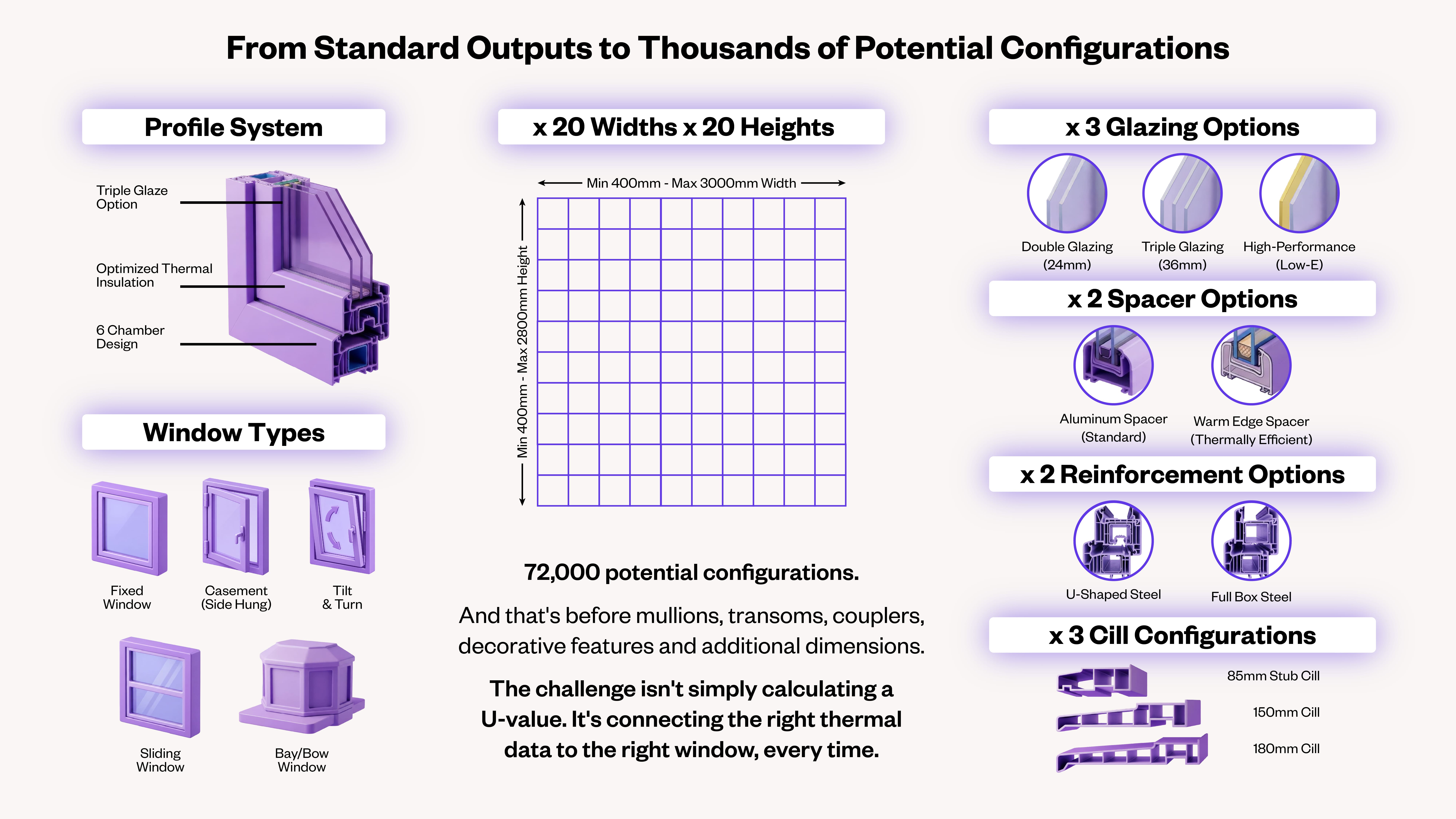
It doesn't include different mullion and transom arrangements, coupling sections, decorative features or the much broader range of dimensions that many manufacturers offer.
Not every possible combination will be manufactured, and not every configuration will necessarily produce a unique U-value. But the example demonstrates how quickly the number of potential outcomes can grow.
For manufacturers operating across multiple profile systems, that complexity increases again.
The challenge isn't simply storing more values. It's reliably connecting validated thermal information to the correct window configuration so the resulting calculation can be supported by evidence and certification appropriate to the finished product.
From standard labels to configuration-specific evidence
That scale also changes how we need to think about the process beyond the calculation itself.
Historically, a relatively manageable number of standard thermal results meant some manufacturers could rely on a predefined set of thermal performance labels and associated documentation, keep them at the production line and have an operator select the appropriate output for the product being manufactured.
That approach was practical because the number of possible outcomes was relatively contained.
Demonstrating the thermal performance of actual window configurations changes the equation.
When dimensions and individual component choices can influence the result, manually matching every window to a library of predefined outcomes becomes increasingly difficult to manage with confidence.
This is why preparing for the Future Homes Standard isn't simply about finding a way to perform a calculation. Businesses also need to consider how accurate product information follows each window through their processes and ultimately supports the evidence associated with that product.
Preparation can start today
There are still details being worked through across the industry, including how thermal information will be validated, distributed and maintained. Different suppliers may also take different approaches.
Manufacturers don't need to wait for every answer before beginning to prepare.
Understanding where thermal information comes from today is a useful starting point. Who maintains it? How is supplier information updated? How easily can the business accommodate data from different suppliers? And how confident are teams that the information being used accurately reflects the products being manufactured?
These questions help identify where existing processes are already strong and where greater preparation may be needed ahead of March 2027.
Preparing with confidence
Actual window calculations represent more than a change in how a U-value is produced.
They place greater importance on the information behind that calculation and the connections between suppliers, manufacturers and the processes they use every day.
One principle is clear: greater accuracy in the final result requires greater confidence in the data behind it.
For manufacturers, understanding that data landscape now is an important part of preparing for what comes next.
Continue the conversation
We'll be exploring these topics in more depth in our upcoming Preparing for the Future Homes Standard webinar.
We'll begin by walking through the key changes and what they mean for manufacturers before bringing together a panel of manufacturers and leading profile suppliers to share their perspectives on how the industry is preparing.
Share this article

Related blogs
Why Two Windows Built from the Same System Can Have Different U-Values
 Windows, Doors & Glass
2026/07/28
In the first article in this series, we explored why the Future Homes Standard represents a significant shift in how the industry demonstrates thermal performance. While the underlying calculation methodology remains familiar, the move from notional window sizes to calculations based on actual dimensions and configurations changes how performance is evidenced throughout the supply chain.

Why the Future Homes Standard is Changing How Windows Are Measured
Windows, Doors & Glass
2026/07/08
If you've worked in the window and door industry for any length of time, you'll know that regulation is nothing new. From changes to Building Regulations and Approved Document L through to evolving energy efficiency standards, our industry has continually adapted to meet new requirements while continuing to deliver high-performing products for homeowners and housebuilders.
How integration addresses labor gaps in window and glass plants
Windows, Doors & Glass
2025/08/19
Learn how integrated systems can help profile houses, window, door, architectural openings and flat glass fabricators overcome skilled labor shortages, reduce strain on teams, and future-proof operations.