What AI Really Changes for Living Spaces Retail
Kitchen Bathroom Flooring

Steven McMullen
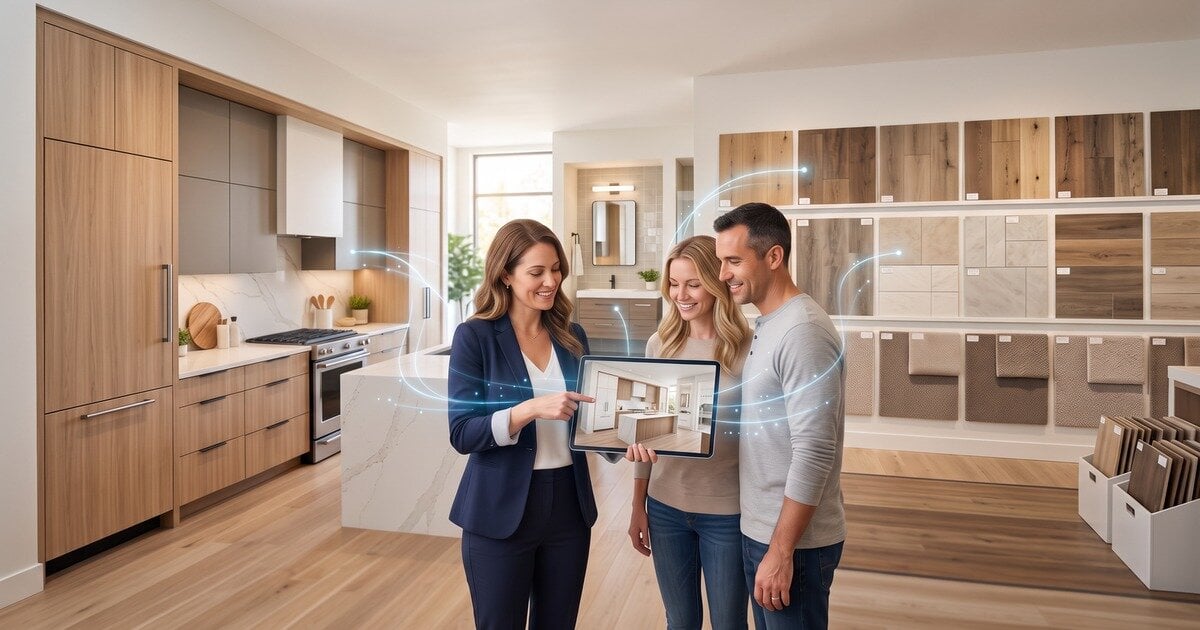
When Inspiration Starts With an AI-Generated Image
A homeowner walks into a showroom holding a smartphone. On screen is an image generated by a consumer AI prompt. It shows floor-to-ceiling walnut cabinetry, an unsupported marble island, and wide-plank hardwood running into a curbless wet room.
The image looks striking. It is also practically impossible.
The cabinet layout ignores standard box sizes. The plank style belongs to a collection discontinued years ago. The plumbing stack sits on the wrong wall.
A common reaction is to dismiss the picture as unrealistic. That is an expensive mistake.
That image is often the clearest brief a customer will bring all year. It reveals preferences about tone, natural light, spatial balance, and finish that would otherwise take hours of conversation to uncover. The opportunity for retailers is not to critique the image, but to translate it.
Retailers who succeed do not dismiss the idea. They invite the customer to explore how to achieve that look in their actual space. Most importantly, they ground that vision in products that can actually be ordered, delivered, and installed.
The Gap Between Beautiful Fiction and Buildable Fact
The tension facing living spaces retail today is not whether customers will use AI. They already do. The tension is where that exploration happens and what happens to the output.
Consumer AI image generators operate on visual probability, not physical properties. They do not know load-bearing walls, clearance standards, plumbing requirements, or manufacturer lead times. They generate beautiful fiction.
When shoppers explore ideas on generic platforms, that excitement remains disconnected from commercial reality. They spend weeks falling in love with impossible layouts. Then they feel deflated when a designer must walk them back to reality in the showroom.
Retailers face a strategic choice. They can wait for customers to arrive with unbuildable concepts from third-party apps. Or they can provide digital spaces where visual inspiration connects directly with real products from the first click.
Getting Found Across Search and AI Answer Engines
The shift to AI affects how customers discover a showroom long before they save their first room render.
Kitchen, bath, and flooring purchases involve months of consideration. Today, shoppers conduct that research across two distinct surfaces: traditional search engines and conversational AI answer engines. Both surfaces rely on the same operational fundamentals to evaluate a business.
- First is review recency and volume. Consistent reviews submitted over the last thirty days signal an actively trading, trustworthy business. AI answer engines prioritize fresh sentiment over stale ratings from two years ago.
- Second is local listing accuracy. Business names, physical addresses, operating hours, and product categories must match across directories. Inconsistencies across Google, Houzz, Yelp, and trade listings quietly suppress search confidence.
- Third is structured on-site content. Fast page speeds, responsive mobile layouts, and location-relevant product pages determine whether AI models can index a retailer's offering accurately.
Consistency compounds over time. Publishing one relevant content page and gathering five customer reviews every month outperforms an irregular push twice a year. Regularity builds lasting search authority.
Moving From Vague Inspiration to Formed Preference
A shopper browsing at nine in the evening is rarely ready to submit a formal quote request. They are testing ideas, comparing styles, and weighing possibilities. A website that presents a static brochure and waits for a form submission inevitably sees high bounce rates.
Progress comes from giving shoppers interactive ways to test ideas against real products.
Room visualizers allow visitors to upload their own room photos. They can preview actual floorings, countertops, or cabinetry with perspective and lighting adjustments. For flooring retailers, connecting this discovery to manufacturer-fulfilled sample requests turns passive browsing into a tangible physical touchpoint.
Conversational AI chat assistants further bridge this gap by answering product and availability questions after hours. When customer questions are answered immediately, shoppers stay engaged on the retailer's site rather than returning to search results.
Looking ahead, the industry is moving toward a more integrated vision. Digital product catalogs will connect more deeply with generative models. Online tools will increasingly allow shoppers to reimagine their rooms using a retailer's active supplier catalog. The long-term goal is simple: ensure that the visual concepts inspiring homeowners are grounded in real products from day one.
Eliminating Blind First Appointments
Sales opportunities in home improvement are rarely lost in a single dramatic moment. They slip away during quiet handoffs between online discovery and the design consultation.
Consider the typical path. A homeowner spends two hours experimenting with colors and layouts on a website. They submit an inquiry form on Sunday. On Monday morning, a sales representative receives an email with a name and phone number, but none of the context. The designer starts the initial consultation from scratch, asking the customer to repeat everything they explored over the weekend.
When online discovery tools link directly with operational and design software, that friction disappears. Visualizer selections, sample orders, and conversational chat transcripts arrive attached to the customer inquiry in a unified lead view.
When a designer reaches out, they already know the room dimensions, style preferences, and specific product collections the homeowner explored. The first appointment becomes a continuation of an ongoing conversation rather than an interrogation.
Industry data confirms the value of connected discovery. Flooring retailers using connected website platforms have reported increases of 67% to 162% in combined website and phone inquiries.*
*Results show the improvement, based on real-life customer data. Actual improvements may vary depending on specific implementation circumstances.
What Technology Changes and What It Protects
Adopting digital tools does not mean handing the customer relationship over to an algorithm. Retailers must be clear on what digital systems can accomplish and what remains fundamentally human.
Digital tools cannot replace professional design judgment, spatial empathy, or trusted project management. Homeowners do not invest tens of thousands of dollars in a renovation based solely on an automated render. They buy confidence, and confidence comes from human expertise. Furthermore, technology cannot solve disconnected operations. If a website, customer pipeline, and back-office ordering software live in disconnected silos, automated tools merely help errors travel faster.
Where Retailers Should Begin
The most effective starting point is to identify the single handoff that costs your business the most momentum. For many businesses, that friction sits at the very beginning of the customer journey, where online visitors disengage before reaching a salesperson.
Cyncly Websites addresses this friction directly. It provides kitchen, bathroom, and flooring retailers with a digital platform built specifically for complex living spaces. By combining live digital product catalogs, interactive room visualization, and 24/7 conversational assistance, it keeps shoppers engaged. By passing full context into operational software, it ensures online inspiration leads directly to booked appointments.
The homeowner with an inspirational image on their phone is going to visit someone's showroom this weekend. When your digital experience connects inspiration to buildable reality, that showroom will be yours.
Share this article

Related blogs
Homebase just got smarter. Here’s what’s new.
 Flooring
Kitchen
Bathroom
7/23/2026
Discover Cyncly Websites' June 2026 updates, featuring five powerful lead management upgrades in Homebase and a visual media library grid view.
What software do kitchen designers use? An honest look at the tools professionals rely on
Kitchen
7/21/2026
Explore the essential software kitchen designers use, from CAD to specialized platforms like Cyncly Design Flex and Winner Flex.
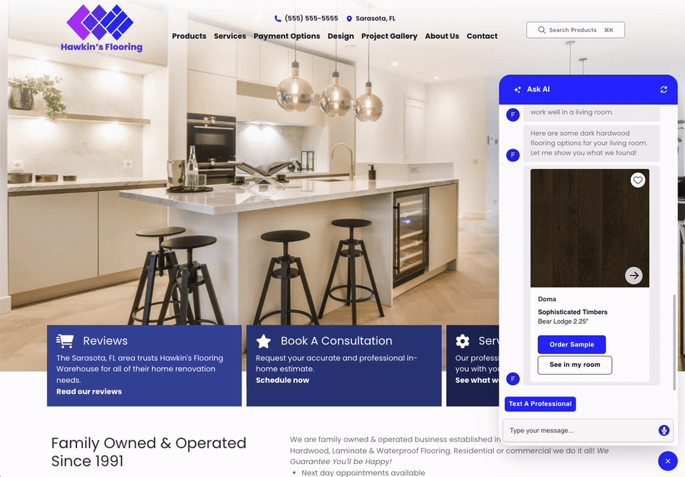
The Connected K&B Website: From First Search To First Consultation
Kitchen
Bathroom
7/20/2026
A K&B shopper spends months researching before contacting a retailer. A connected website lets her explore products, form preferences, and book a consultation at 9pm on a Tuesday — and delivers everything she did to the designer's inbox before the first call. This article walks the nine signals that show where the gaps are and the 90-day path to closing them.