Why the Future Homes Standard is Changing How Windows Are Measured
Finestre, porte e vetri

Phil Wilson

If you've worked in the window and door industry for any length of time, you'll know that regulation is nothing new. From changes to Building Regulations and Approved Document L through to evolving energy efficiency standards, our industry has continually adapted to meet new requirements while continuing to deliver high-performing products for homeowners and housebuilders.
The Future Homes Standard (FHS) is another significant milestone, but this time, it feels different.
Not because it's introducing a completely new way of measuring thermal performance. In fact, the underlying calculation methodology has been established for years. What is changing is how that methodology is applied and, ultimately, how manufacturers, fabricators and installers demonstrate compliance.
Over the past few months, I've been speaking with customers, profile suppliers and other industry stakeholders about the Future Homes Standard. One thing has become clear: while most people know change is coming, there is still uncertainty about why it's happening and what it will mean in practice.
This first article aims to answer those questions.
Why is the industry changing?
The UK's commitment to improving the energy efficiency of homes is well documented. As building standards continue to evolve, every element of a property's thermal performance is coming under greater scrutiny.
Windows have always played an important role in a building's overall energy efficiency, but as homes become better insulated and more airtight, relatively small differences in window performance become much more significant.
Historically, for new build specifications, the industry has been able to demonstrate thermal performance using a "notional" window, specifically the standard reference size defined under BS EN ISO 10077-1.
The Compliance Catalyst: Today's homes demand greater accuracy. Alongside the FHS, the government is replacing the legacy SAP compliance engine with the new Home Energy Model (HEM). Unlike SAP, HEM utilises highly granular, half-hourly climate data simulations and requires housebuilders to input the exact configuration, physical dimensions, and structural orientations of every single aperture on a plot.
For many years, that approach served the industry well.
However, today's homes demand greater accuracy.
A small bathroom window and a large picture window may use exactly the same profile system, glazing unit and spacer bar, yet their thermal performance will not be identical. Their proportions are different, their frame-to-glass ratios differ, and the amount of heat transferred through each component changes accordingly.
The Future Homes Standard recognises this reality by moving away from notional window sizes towards calculations based on the actual dimensions and configuration of every individual window.
The objective isn't to make compliance more complicated. It's to ensure the thermal performance being declared is a more accurate representation of the product that will ultimately be installed.
"The biggest change isn't the thermal target itself, it's how the industry demonstrates the performance of every individual window."
It's not a new calculation, it's a new application
One of the biggest misconceptions I've encountered is that the Future Homes Standard introduces a completely new thermal calculation.
It doesn't.
The industry will continue to use the recognised methodology defined within BS EN ISO 10077 (Parts 1 and 2) for calculating whole-window U-values.
What's changing is the data that feeds that calculation.
Instead of applying the calculation to a standard reference window, it will be applied to the actual window being manufactured.
That means the size, proportions and configuration of every window become important.
This is a subtle but significant shift.
For many businesses, it won't necessarily change the products they manufacture. It changes how those products are assessed and how compliance is demonstrated.
Why actual windows matter
To understand why this change has been introduced, it's helpful to think about two windows manufactured using exactly the same components.
Imagine one is a relatively small bathroom window.
The other is a large feature window for a living room.
Traditionally, both products may have shared the same published U-value because they belonged to the same window system.
Under the Future Homes Standard, that assumption no longer holds true.
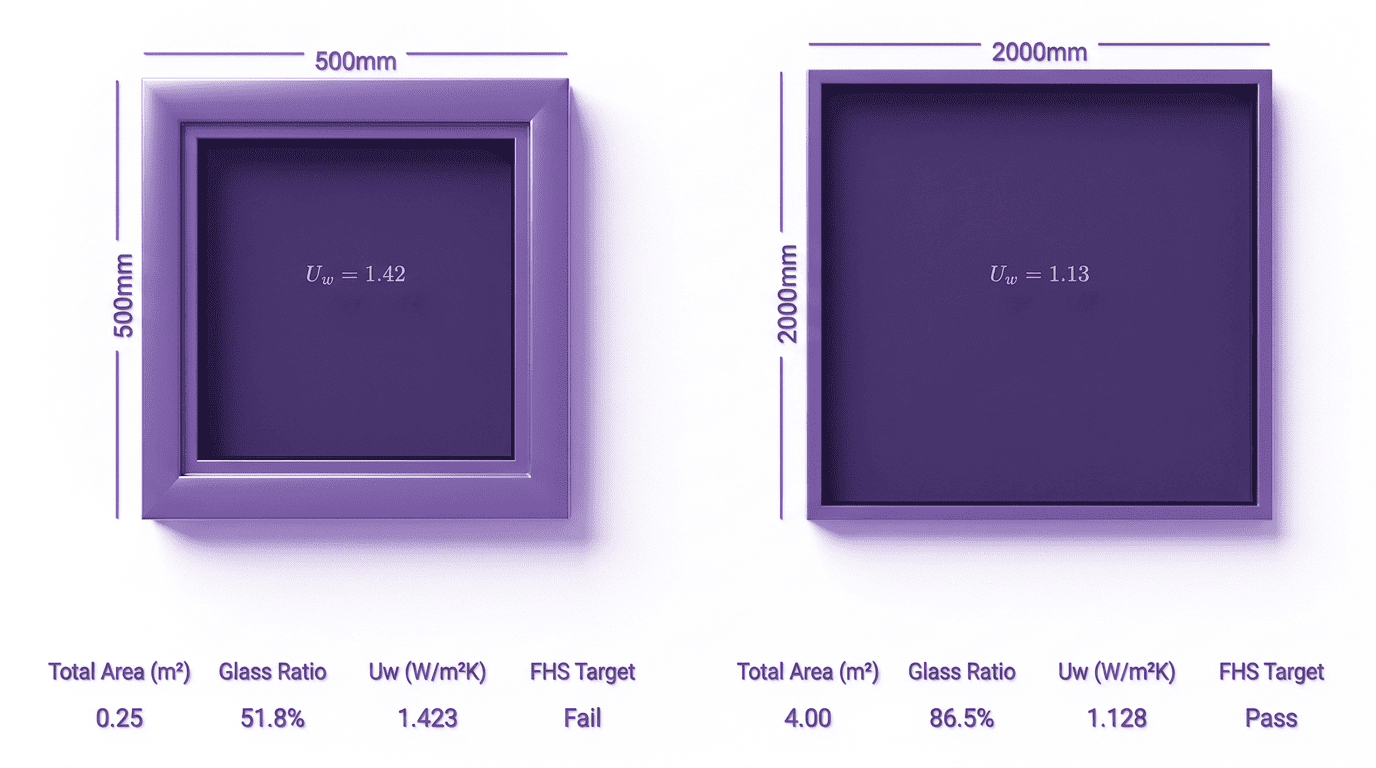
The smaller window contains proportionally more frame than glass. Since frame and glazing contribute differently to overall thermal performance, the resulting whole-window U-value will naturally differ from the larger window.
Now consider the impact of additional design features.
Adding mullions or transoms changes the amount of frame within the window.
Different cills may influence thermal performance.
Spacer systems contribute to linear thermal bridging around the edge of the glass.
Decorative features and internal frame reinforcements (like steel or thermal plastics) can also affect the final result. None of these are new products or new engineering challenges, they're simply being recognised more accurately within the compliance process.
This is bigger than software
Whenever a new regulation is introduced, it's easy to assume the biggest challenge will be updating software.
In reality, I believe the bigger challenge lies elsewhere.
The Future Homes Standard affects almost every organisation involved in the supply chain.
Profile suppliers will need to provide validated thermal performance data across their product ranges.
Glass manufacturers and spacer suppliers must ensure their published values are accurate and readily available.
Fabricators will need confidence that the data they're using reflects the products they're manufacturing.
Installers and housebuilders will increasingly need evidence that demonstrates compliance for the windows being supplied.
Software, of course, plays an important role in bringing all of this information together, but software is only one part of a much wider ecosystem.
Success depends on accurate data, consistent processes and close collaboration across the industry.
Preparing for the transition
As the key implementation deadlines loom and the industry actively transitions, the time to prepare is now.
Businesses should already be considering questions such as:
- Are we talking to our profile suppliers about thermal performance data?
- Do we understand how these changes could affect our quoting and compliance processes?
- Are our customers beginning to ask questions about the Future Homes Standard?
- What internal knowledge and training will our teams need over the coming months?
These conversations don't need all the answers today, but they do need to start.
One thing I've learned through discussions with customers and suppliers is that everyone recognises the direction of travel. The organisations that begin preparing early will be in a far stronger position as the regulations come into force.
Looking ahead
The Future Homes Standard isn't asking the industry to manufacture completely different windows.
It's asking us to demonstrate the performance of those windows more accurately than ever before.
That may sound like a subtle distinction, but it's one that will influence product data, compliance processes, software and day-to-day operations across the industry.
In the next article in this series, we'll explore one of the biggest practical implications of this change: why two windows manufactured from the same profile system can now produce different whole-window U-values, and why understanding window geometry is becoming increasingly important.
Share this article

Related blogs

Preparing Your Business for the Future Homes Standard: Why Good Data Matters
 Finestre, porte e vetri
17/09/2026
As manufacturers prepare for the Future Homes Standard, there's understandably a lot of focus on calculating a U-value for an individual window. But producing the calculation is only part of the challenge.
Why Two Windows Built from the Same System Can Have Different U-Values
Finestre, porte e vetri
28/07/2026
In the first article in this series, we explored why the Future Homes Standard represents a significant shift in how the industry demonstrates thermal performance. While the underlying calculation methodology remains familiar, the move from notional window sizes to calculations based on actual dimensions and configurations changes how performance is evidenced throughout the supply chain.
Come l’integrazione affronta la carenza di manodopera negli impianti di finestre e vetro
Finestre, porte e vetri
19/08/2025
Scopri come i sistemi integrati possano aiutare a profilare case, finestre, porte, aperture architettoniche e fabbricanti di vetro piatto a superare la carenza di manodopera qualificata, ridurre la pressione sui team e garantire operazioni a prova di futuro.